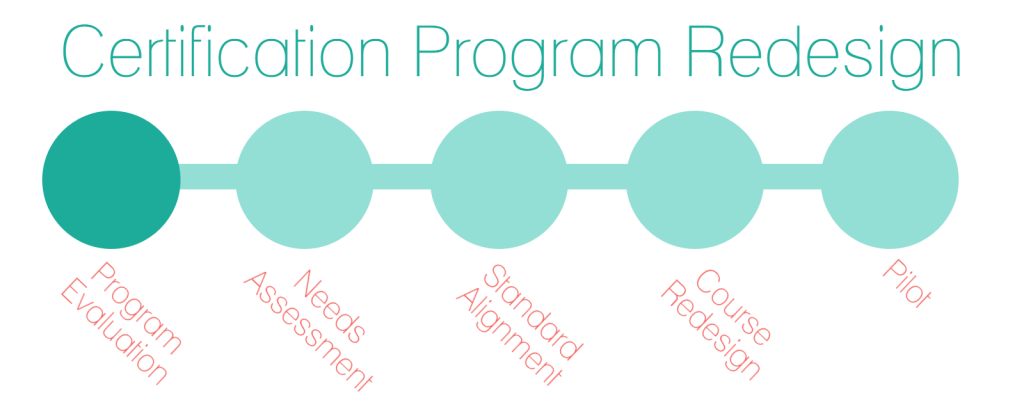
When I talk to people about the Digital Education Leadership program through Seattle Pacific University, I often end up saying, “Well, there’s homework, but it’s not really homework. I do work, but it’s directly related to my responsibilities as a librarian and an educator. So, it’s homework but it’s not really homework. It’s bigger than that. It has more significance than ‘homework.'” While this has been proven throughout the duration of the program, it couldn’t have been more true than when I was offered the opportunity to redesign a Library Media Endorsement certification program… As part of my “homework.”
My classmates and I were recently tasked with conducting a program evaluation. Students learned “how to conduct needs assessments, develop technology-related professional learning programs, evaluate the impact on instructional practice and student learning, and communicate findings to the institution” (Course syllabus). Dr. David Wicks, Chair of the Digital Education Leadership program, came to me with a wonderful opportunity to redesign a university’s Library Media Endorsement (LME) certification program. Because the program is not yet finalized, I am omitting the name of the institution and it will henceforth be identified as “University.”
Program Evaluation
The project was designed to evaluate … Read More
]]>
When I talk to people about the Digital Education Leadership program through Seattle Pacific University, I often end up saying, “Well, there’s homework, but it’s not really homework. I do work, but it’s directly related to my responsibilities as a librarian and an educator. So, it’s homework but it’s not really homework. It’s bigger than that. It has more significance than ‘homework.'” While this has been proven throughout the duration of the program, it couldn’t have been more true than when I was offered the opportunity to redesign a Library Media Endorsement certification program… As part of my “homework.”
My classmates and I were recently tasked with conducting a program evaluation. Students learned “how to conduct needs assessments, develop technology-related professional learning programs, evaluate the impact on instructional practice and student learning, and communicate findings to the institution” (Course syllabus). Dr. David Wicks, Chair of the Digital Education Leadership program, came to me with a wonderful opportunity to redesign a university’s Library Media Endorsement (LME) certification program. Because the program is not yet finalized, I am omitting the name of the institution and it will henceforth be identified as “University.”
Program Evaluation
The project was designed to evaluate … Read More
]]>
While I am still processing the difference between the many sets of standards, I am approaching my exploration this semester from the perspective of a librarian who is there to serve both students and teachers in order to take their learning and teaching to the next level. This week, I was given the following question and asked to explore it in a way … Read More
]]>While I am still processing the difference between the many sets of standards, I am approaching my exploration this semester from the perspective of a librarian who is there to serve both students and teachers in order to take their learning and teaching to the next level. This week, I was given the following question and asked to explore it in a way … Read More
]]>I recently attended an EdCamp (if you’re unfamiliar with the term, this video is a must) where I met with several librarians who were talking about the need for basic computer skill instruction. After much discussion and reflecting on the standard for this week, I was left asking myself the following question:
How can the library play a central role in facilitating a scope and sequence of computer skills for students in the … Read More
]]>I recently attended an EdCamp (if you’re unfamiliar with the term, this video is a must) where I met with several librarians who were talking about the need for basic computer skill instruction. After much discussion and reflecting on the standard for this week, I was left asking myself the following question:
How can the library play a central role in facilitating a scope and sequence of computer skills for students in the … Read More
]]>I recently started teaching sixth and seventh grade students the research process using the Big6™ Research Model, you can read more about that experience in my last blog post. During that lesson, I found that the students’ biggest challenges were some of the skills I thought would be the most simple. The most notable being, the ability to identify keywords that would help them conduct their research. The students were able to formulate several questions related to their science fair topic but when asked to select three to five keywords based on those questions, they struggled. My intended goal for the students was for them to review their questions, determine how those questions were related, and extract a number of succinct terms that will allow them to conduct effective research. I discovered … Read More
]]>I recently started teaching sixth and seventh grade students the research process using the Big6 Research Model, you can read more about that experience in my last blog post. During that lesson, I found that the students’ biggest challenges were some of the skills I thought would be the most simple. The most notable being, the ability to identify keywords that would help them conduct their research. The students were able to formulate several questions related to their science fair topic but when asked to select three to five keywords based on those questions, they struggled. My intended goal for the students was for them to review their questions, determine how those questions were related, and extract a number of succinct terms that will allow them to conduct effective research. I discovered … Read More
Coincidentally, our middle school science teacher approached me recently, asking if I could guide her students through the research process as they prepare their science fair projects. While I have taught several stand-alone lessons on conducting research, I have never taught those skills as a thoughtful, comprehensive unit. I took to the Web to discover how other educators teach various information literacy skills and through my research, I have discovered that I am not alone; it is not uncommon for librarians to lack confidence in their implementation of research skills in their program. Dr. Michael B. Eisenberg, founder of the Big6™Skills and Janet Murray, well-published and respected school librarian, have indicated that a surprisingly few number of schools have a comprehensive information literacy program. They found that many programs are “irregular, partial, and arbitrary” (Eisenberg, 2011, pg. 10). Sadly, as our classrooms (and world) move towards an inquiry-based model, … Read More
]]>Coincidentally, our middle school science teacher approached me recently, asking if I could guide her students through the research process as they prepare their science fair projects. While I have taught several stand-alone lessons on conducting research, I have never taught those skills as a thoughtful, comprehensive unit. I took to the Web to discover how other educators teach various information literacy skills and through my research, I have discovered that I am not alone; it is not uncommon for librarians to lack confidence in their implementation of research skills in their program. Dr. Michael B. Eisenberg, founder of the Big6Skills and Janet Murray, well-published and respected school librarian, have indicated that a surprisingly few number of schools have a comprehensive information literacy program. They found that many programs are “irregular, partial, and arbitrary” (Eisenberg, 2011, pg. 10). Sadly, as our classrooms (and world) move towards an inquiry-based model, … Read More