One of the biggest takeaways from my time in the Digital Education Leadership program through Seattle Pacific University is that teachers are students, too. When diving into effective mentoring and professional development, some of the most successful strategies are those that are also used in the classroom. Many back-to-school workshops remind teachers to get to know their students and provide differentiation in every learning experience. In other words, providing learners (adults included) with a pre-assessment (formal or informal) to determine where they are in order to reach where they need to be.
Edutopia has a great article and video that touches on the importance of assessment before learning even begins:
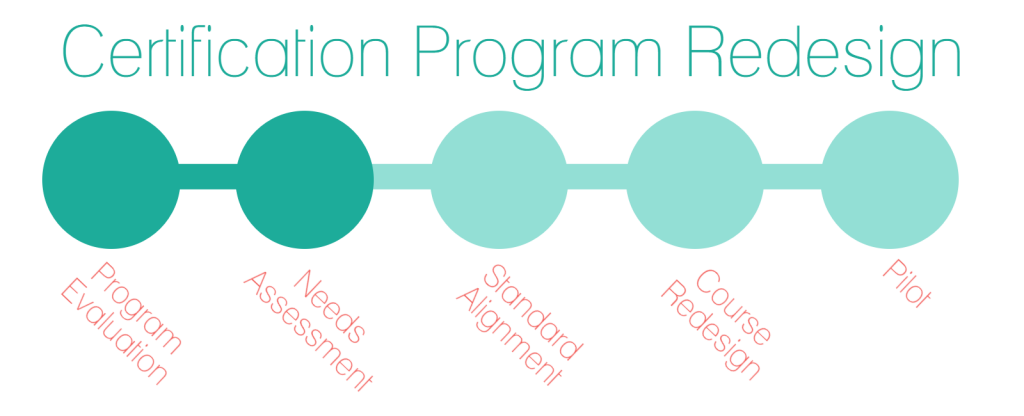
In an earlier post, I wrote about my journey in reviewing and redesigning a university’s Library Media Endorsement (LME) certification program. Here, I continue that work by drafting a Needs Assessment survey for potential students. As I mentioned in my last post, the program is not yet finalized, so I am omitting the name of the institution and it will henceforth be identified as “University.”
Before writing the Needs Assessment survey, I did a bit of background research, attempting to see how other schools have assessed their incoming … Read More
]]>
One of the biggest takeaways from my time in the Digital Education Leadership program through Seattle Pacific University is that teachers are students, too. When diving into effective mentoring and professional development, some of the most successful strategies are those that are also used in the classroom. Many back-to-school workshops remind teachers to get to know their students and provide differentiation in every learning experience. In other words, providing learners (adults included) with a pre-assessment (formal or informal) to determine where they are in order to reach where they need to be.
Edutopia has a great article and video that touches on the importance of assessment before learning even begins:
In an earlier post, I wrote about my journey in reviewing and redesigning a university’s Library Media Endorsement (LME) certification program. Here, I continue that work by drafting a Needs Assessment survey for potential students. As I mentioned in my last post, the program is not yet finalized, so I am omitting the name of the institution and it will henceforth be identified as “University.”
Before writing the Needs Assessment survey, I did a bit of background research, attempting to see how other schools have assessed their incoming … Read More
]]>
When I talk to people about the Digital Education Leadership program through Seattle Pacific University, I often end up saying, “Well, there’s homework, but it’s not really homework. I do work, but it’s directly related to my responsibilities as a librarian and an educator. So, it’s homework but it’s not really homework. It’s bigger than that. It has more significance than ‘homework.'” While this has been proven throughout the duration of the program, it couldn’t have been more true than when I was offered the opportunity to redesign a Library Media Endorsement certification program… As part of my “homework.”
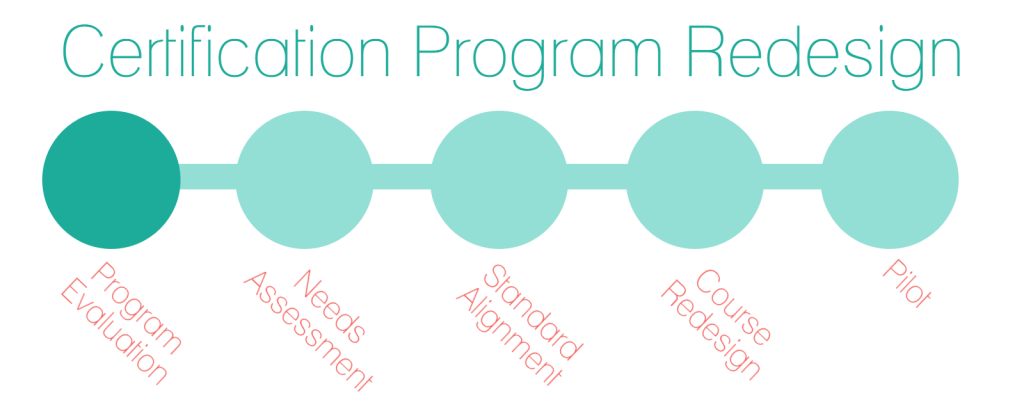
My classmates and I were recently tasked with conducting a program evaluation. Students learned “how to conduct needs assessments, develop technology-related professional learning programs, evaluate the impact on instructional practice and student learning, and communicate findings to the institution” (Course syllabus). Dr. David Wicks, Chair of the Digital Education Leadership program, came to me with a wonderful opportunity to redesign a university’s Library Media Endorsement (LME) certification program. Because the program is not yet finalized, I am omitting the name of the institution and it will henceforth be identified as “University.”
Program Evaluation
The project was designed to evaluate … Read More
]]>
When I talk to people about the Digital Education Leadership program through Seattle Pacific University, I often end up saying, “Well, there’s homework, but it’s not really homework. I do work, but it’s directly related to my responsibilities as a librarian and an educator. So, it’s homework but it’s not really homework. It’s bigger than that. It has more significance than ‘homework.'” While this has been proven throughout the duration of the program, it couldn’t have been more true than when I was offered the opportunity to redesign a Library Media Endorsement certification program… As part of my “homework.”
My classmates and I were recently tasked with conducting a program evaluation. Students learned “how to conduct needs assessments, develop technology-related professional learning programs, evaluate the impact on instructional practice and student learning, and communicate findings to the institution” (Course syllabus). Dr. David Wicks, Chair of the Digital Education Leadership program, came to me with a wonderful opportunity to redesign a university’s Library Media Endorsement (LME) certification program. Because the program is not yet finalized, I am omitting the name of the institution and it will henceforth be identified as “University.”
Program Evaluation
The project was designed to evaluate … Read More
]]>Technology coaches conduct needs assessments, develop technology-related professional learning programs, and evaluate the impact on instructional practice and student learning.
Over the last several weeks, my classmates and I have learned how to implement a successful professional development program and I have identified the following elements as being most useful when evaluating a professional development program:
Sadly, professional development is generally “something that is ‘done’ to teachers” (Pilar, 2014). Teachers need opportunities to explore their own interests and venture into those topics at a personalized level that works for their individual learning styles. In a study conducted by the Center for Professional Education, it was found that “90% of teachers reported participating in some form of professional development, and they also reported that it was not helpful in their practice. Thus, professional development is happening, but it is not effective” (Blattner, 2015). Imagine a place where teachers drive their learning by expressing their interests, learning at their own pace, implementing their discoveries and reflecting on their current and future practices. … Read More
]]>Technology coaches conduct needs assessments, develop technology-related professional learning programs, and evaluate the impact on instructional practice and student learning.
Over the last several weeks, my classmates and I have learned how to implement a successful professional development program and I have identified the following elements as being most useful when evaluating a professional development program:
Sadly, professional development is generally “something that is ‘done’ to teachers” (Pilar, 2014). Teachers need opportunities to explore their own interests and venture into those topics at a personalized level that works for their individual learning styles. In a study conducted by the Center for Professional Education, it was found that “90% of teachers reported participating in some form of professional development, and they also reported that it was not helpful in their practice. Thus, professional development is happening, but it is not effective” (Blattner, 2015). Imagine a place where teachers drive their learning by expressing their interests, learning at their own pace, implementing their discoveries and reflecting on their current and future practices. … Read More
]]>Technology coaches conduct needs assessments, develop technology-related professional learning programs, and evaluate the impact on instructional practice and student learning:
a. Conduct needs assessments to inform the content and delivery of technology-related professional learning programs that result in a positive impact on student learning
b. Design, develop, and implement technology-rich professional learning programs that model principles of adult learning and promote digital age best practices in teaching, learning, and assessment learning experiences using a variety of research-based, learner-centered instructional strategies and assessment tools to address the diverse needs and interests of all students
c. Coach teachers in and model engagement of students in local and global interdisciplinary units in which technology helps students assume professional roles, research real-world problems, collaborate with others, and produce products that are meaningful and useful to a wide audience
d. Coach teachers in and model design … Read More
Technology coaches conduct needs assessments, develop technology-related professional learning programs, and evaluate the impact on instructional practice and student learning:
a. Conduct needs assessments to inform the content and delivery of technology-related professional learning programs that result in a positive impact on student learning
b. Design, develop, and implement technology-rich professional learning programs that model principles of adult learning and promote digital age best practices in teaching, learning, and assessment learning experiences using a variety of research-based, learner-centered instructional strategies and assessment tools to address the diverse needs and interests of all students
c. Coach teachers in and model engagement of students in local and global interdisciplinary units in which technology helps students assume professional roles, research real-world problems, collaborate with others, and produce products that are meaningful and useful to a wide audience
d. Coach teachers in and model design … Read More

While the entire Digital Education Leadership program at Seattle Pacific University is designed to be a hands-on experience which embeds learning opportunities into students’ current workplace, this course, in particular, provided students with a meaningful opportunity to practice our newfound skills in a professional environment. Under the tutelage of Dr. David Wicks, Associate Professor and Chair of the Digital Education Leadership program and Dr. Les Foltos, Director of Educational Innovation at Peer-Ed and author of Peer Coaching: Unlocking the Power of Collaboration, students were trained as peer coaches and we worked with a collaborating teacher from our respective schools. I chronicled that learned and the skills I obtained in posts throughout the quarter and now, as this course comes to a close, I’m reflecting on the work that was done and thinking about how to sustain my skills as a peer coach in the future.
The importance of peer coaching practice in schools became evident to me very quickly into the quarter. Teachers that are supported create students that are successful. Well-renowned researchers of teaching methods and staff development, Bruce Joyce and Beverly Showers, have found that teachers that have been coached generally demonstrate the following:
- Practiced
While the entire Digital Education Leadership program at Seattle Pacific University is designed to be a hands-on experience which embeds learning opportunities into students’ current workplace, this course, in particular, provided students with a meaningful opportunity to practice our newfound skills in a professional environment. Under the tutelage of Dr. David Wicks, Associate Professor and Chair of the Digital Education Leadership program and Dr. Les Foltos, Director of Educational Innovation at Peer-Ed and author of Peer Coaching: Unlocking the Power of Collaboration, students were trained as peer coaches and we worked with a collaborating teacher from our respective schools. I chronicled that learned and the skills I obtained in posts throughout the quarter and now, as this course comes to a close, I’m reflecting on the work that was done and thinking about how to sustain my skills as a peer coach in the future.
The importance of peer coaching practice in schools became evident to me very quickly into the quarter. Teachers that are supported create students that are successful. Well-renowned researchers of teaching methods and staff development, Bruce Joyce and Beverly Showers, have found that teachers that have been coached generally demonstrate the following:
- Practiced
What are 21st century skills and how can they be incorporated into the classroom in a meaningful way that enhances the curriculum?
Before I can explore the implementation of 21st century skills, I needed to pause and illustrate what a 21st century learner might look like:

The National Council of Teachers of English define a 21st century learner as someone who is able to:
- Develop proficiency and fluency with the tools of technology,
- Build intentional cross-cultural connections and relationships with others so to pose and solve problems collaboratively and strengthen independent thought,
- Design and share information for global communities to meet a variety of purposes,
- Manage, analyze, and synthesize multiple streams of simultaneous information,
- Create, critique,
What are 21st century skills and how can they be incorporated into the classroom in a meaningful way that enhances the curriculum?
Before I can explore the implementation of 21st century skills, I needed to pause and illustrate what a 21st century learner might look like:
The National Council of Teachers of English define a 21st century learner as someone who is able to:
- Develop proficiency and fluency with the tools of technology,
- Build intentional cross-cultural connections and relationships with others so to pose and solve problems collaboratively and strengthen independent thought,
- Design and share information for global communities to meet a variety of purposes,
- Manage, analyze, and synthesize multiple streams of simultaneous information,
- Create, critique,
While this activity was designed to train peer coaches, the communication skills are useful in all collaborative relationships (they were a great reminder for all areas of my life). Les Foltos, Director of Educational Innovation at Peer-Ed and author of … Read More
]]>While this activity was designed to train peer coaches, the communication skills are useful in all collaborative relationships (they were a great reminder for all areas of my life). Les Foltos, Director of Educational Innovation at Peer-Ed and author of … Read More
]]>
My ideal learning environment is one where students:
- Guide their own learning by asking questions and following curiosities.
- Explore ideas that pique their interest, thereby formulating their own units of study.
- Work collaboratively with others both inside and outside of the classroom in an effort to pursue those interests.
- Are encouraged to move freely while still understanding the importance of coming back together and being respectful to others.
- Trust their own instincts and grow into responsible “decision-making” and “self-reliant” learners (Saxena, 2013).
- Have access to the world, in whatever form that makes sense in that time and place.
- Learn from one another.
My ideal learning environment is one where teachers:
- Feel comfortable in stepping down from the stage and allow students to see that they don’t know everything, but they are interested in learning alongside their students.
- Have ample opportunities for asking questions and taking risks while feeling supported and
My ideal learning environment is one where students:
- Guide their own learning by asking questions and following curiosities.
- Explore ideas that pique their interest, thereby formulating their own units of study.
- Work collaboratively with others both inside and outside of the classroom in an effort to pursue those interests.
- Are encouraged to move freely while still understanding the importance of coming back together and being respectful to others.
- Trust their own instincts and grow into responsible “decision-making” and “self-reliant” learners (Saxena, 2013).
- Have access to the world, in whatever form that makes sense in that time and place.
- Learn from one another.
My ideal learning environment is one where teachers:
- Feel comfortable in stepping down from the stage and allow students to see that they don’t know everything, but they are interested in learning alongside their students.
- Have ample opportunities for asking questions and taking risks while feeling supported and
As I move forward in my examination of GAFE, a suite of productivity applications that Google offers free to schools, I am going to look at the pros and cons and how those nuances might play a role in the adoption of this learning tool. With that being said, this is not a review of GAFE, it’s not a comparative list between GAFE and Microsoft. It’s a question of whether or not this specific tool can meet the specific needs of my faculty and students. In his article, Computer Criticism vs. Technocentric Thinking, Seymour Papert argues that when evaluating a new … Read More
]]>As I move forward in my examination of GAFE, a suite of productivity applications that Google offers free to schools, I am going to look at the pros and cons and how those nuances might play a role in the adoption of this learning tool. With that being said, this is not a review of GAFE, it’s not a comparative list between GAFE and Microsoft. It’s a question of whether or not this specific tool can meet the specific needs of my faculty and students. In his article, Computer Criticism vs. Technocentric Thinking, Seymour Papert argues that when evaluating a new … Read More
]]>