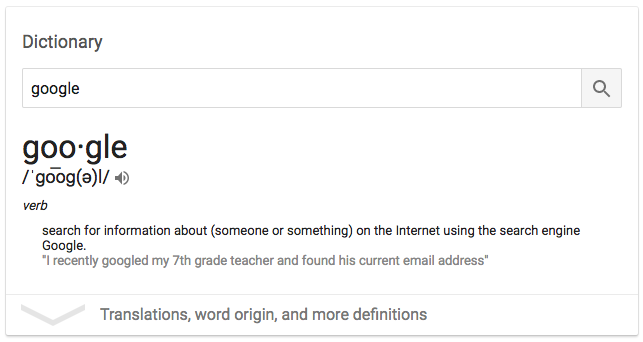
I am here to argue that “googling” is not as intuitive as our students (or society) might think. At least, not highly effective searching. I have been teaching colleagues and students some helpful tips for the last several years and I am always excited to see how in awe they are of these few simple tricks. If you were to do a basic search of “Google Search Tips” you will find a plethora of articles and posts, but these are a few of my favorites:
Try to model some of these treasures with your students and they may have a new appreciation for your superb “Googling” skills. I must note that while I have long been using the term “Googling to the Max” for this presentation, it seems there are several others that use this title, as well. I created the examples within the presentation to specifically suit my audience, … Read More
]]>
I am here to argue that “googling” is not as intuitive as our students (or society) might think. At least, not highly effective searching. I have been teaching colleagues and students some helpful tips for the last several years and I am always excited to see how in awe they are of these few simple tricks. If you were to do a basic search of “Google Search Tips” you will find a plethora of articles and posts, but these are a few of my favorites:
Try to model some of these treasures with your students and they may have a new appreciation for your superb “Googling” skills. I must note that while I have long been using the term “Googling to the Max” for this presentation, it seems there are several others that use this title, as well. I created the examples within the presentation to specifically suit my audience, … Read More
]]>
Technology coaches conduct needs assessments, develop technology-related professional learning programs, and evaluate the impact on instructional practice and student learning.
Over the last several weeks, my classmates and I have learned how to implement a successful professional development program and I have identified the following elements as being most useful when evaluating a professional development program:

Sadly, professional development is generally “something that is ‘done’ to teachers” (Pilar, 2014). Teachers need opportunities to explore their own interests and venture into those topics at a personalized level that works for their individual learning styles. In a study conducted by the Center for Professional Education, it was found that “90% of teachers reported participating in some form of professional development, and they also reported that it was not helpful in their practice. Thus, professional development is happening, but it is not effective” (Blattner, 2015). Imagine a place where teachers drive their learning by expressing their interests, learning at their own pace, implementing their discoveries and reflecting on their current and future practices. … Read More
]]>Technology coaches conduct needs assessments, develop technology-related professional learning programs, and evaluate the impact on instructional practice and student learning.
Over the last several weeks, my classmates and I have learned how to implement a successful professional development program and I have identified the following elements as being most useful when evaluating a professional development program:
Sadly, professional development is generally “something that is ‘done’ to teachers” (Pilar, 2014). Teachers need opportunities to explore their own interests and venture into those topics at a personalized level that works for their individual learning styles. In a study conducted by the Center for Professional Education, it was found that “90% of teachers reported participating in some form of professional development, and they also reported that it was not helpful in their practice. Thus, professional development is happening, but it is not effective” (Blattner, 2015). Imagine a place where teachers drive their learning by expressing their interests, learning at their own pace, implementing their discoveries and reflecting on their current and future practices. … Read More
]]>Technology coaches conduct needs assessments, develop technology-related professional learning programs, and evaluate the impact on instructional practice and student learning:
a. Conduct needs assessments to inform the content and delivery of technology-related professional learning programs that result in a positive impact on student learning
b. Design, develop, and implement technology-rich professional learning programs that model principles of adult learning and promote digital age best practices in teaching, learning, and assessment learning experiences using a variety of research-based, learner-centered instructional strategies and assessment tools to address the diverse needs and interests of all students
c. Coach teachers in and model engagement of students in local and global interdisciplinary units in which technology helps students assume professional roles, research real-world problems, collaborate with others, and produce products that are meaningful and useful to a wide audience
d. Coach teachers in and model design … Read More
Technology coaches conduct needs assessments, develop technology-related professional learning programs, and evaluate the impact on instructional practice and student learning:
a. Conduct needs assessments to inform the content and delivery of technology-related professional learning programs that result in a positive impact on student learning
b. Design, develop, and implement technology-rich professional learning programs that model principles of adult learning and promote digital age best practices in teaching, learning, and assessment learning experiences using a variety of research-based, learner-centered instructional strategies and assessment tools to address the diverse needs and interests of all students
c. Coach teachers in and model engagement of students in local and global interdisciplinary units in which technology helps students assume professional roles, research real-world problems, collaborate with others, and produce products that are meaningful and useful to a wide audience
d. Coach teachers in and model design … Read More

References
Generation Ready. (n.d.). Raising student achievement through professional development. Retrieved January 27, 2016, from http://www.generationready.com/wp-content/uploads/2013/10/PD-White-Paper.pdf
Regional Educational Laboratory. (2007, October). Reviewing the evidence on how teacher professional development affects student achievement. Issues & Answers, (33), iii-31. Retrieved from http://ies.ed.gov/ncee/edlabs/regions/southwest/pdf/rel_2007033.pdf… Read More
]]>
References
Generation Ready. (n.d.). Raising student achievement through professional development. Retrieved January 27, 2016, from http://www.generationready.com/wp-content/uploads/2013/10/PD-White-Paper.pdf
Regional Educational Laboratory. (2007, October). Reviewing the evidence on how teacher professional development affects student achievement. Issues & Answers, (33), iii-31. Retrieved from http://ies.ed.gov/ncee/edlabs/regions/southwest/pdf/rel_2007033.pdf
]]>
While the entire Digital Education Leadership program at Seattle Pacific University is designed to be a hands-on experience which embeds learning opportunities into students’ current workplace, this course, in particular, provided students with a meaningful opportunity to practice our newfound skills in a professional environment. Under the tutelage of Dr. David Wicks, Associate Professor and Chair of the Digital Education Leadership program and Dr. Les Foltos, Director of Educational Innovation at Peer-Ed and author of Peer Coaching: Unlocking the Power of Collaboration, students were trained as peer coaches and we worked with a collaborating teacher from our respective schools. I chronicled that learned and the skills I obtained in posts throughout the quarter and now, as this course comes to a close, I’m reflecting on the work that was done and thinking about how to sustain my skills as a peer coach in the future.
The importance of peer coaching practice in schools became evident to me very quickly into the quarter. Teachers that are supported create students that are successful. Well-renowned researchers of teaching methods and staff development, Bruce Joyce and Beverly Showers, have found that teachers that have been coached generally demonstrate the following:
- Practiced
While the entire Digital Education Leadership program at Seattle Pacific University is designed to be a hands-on experience which embeds learning opportunities into students’ current workplace, this course, in particular, provided students with a meaningful opportunity to practice our newfound skills in a professional environment. Under the tutelage of Dr. David Wicks, Associate Professor and Chair of the Digital Education Leadership program and Dr. Les Foltos, Director of Educational Innovation at Peer-Ed and author of Peer Coaching: Unlocking the Power of Collaboration, students were trained as peer coaches and we worked with a collaborating teacher from our respective schools. I chronicled that learned and the skills I obtained in posts throughout the quarter and now, as this course comes to a close, I’m reflecting on the work that was done and thinking about how to sustain my skills as a peer coach in the future.
The importance of peer coaching practice in schools became evident to me very quickly into the quarter. Teachers that are supported create students that are successful. Well-renowned researchers of teaching methods and staff development, Bruce Joyce and Beverly Showers, have found that teachers that have been coached generally demonstrate the following:
- Practiced
What are 21st century skills and how can they be incorporated into the classroom in a meaningful way that enhances the curriculum?
Before I can explore the implementation of 21st century skills, I needed to pause and illustrate what a 21st century learner might look like:

The National Council of Teachers of English define a 21st century learner as someone who is able to:
- Develop proficiency and fluency with the tools of technology,
- Build intentional cross-cultural connections and relationships with others so to pose and solve problems collaboratively and strengthen independent thought,
- Design and share information for global communities to meet a variety of purposes,
- Manage, analyze, and synthesize multiple streams of simultaneous information,
- Create, critique,
What are 21st century skills and how can they be incorporated into the classroom in a meaningful way that enhances the curriculum?
Before I can explore the implementation of 21st century skills, I needed to pause and illustrate what a 21st century learner might look like:
The National Council of Teachers of English define a 21st century learner as someone who is able to:
- Develop proficiency and fluency with the tools of technology,
- Build intentional cross-cultural connections and relationships with others so to pose and solve problems collaboratively and strengthen independent thought,
- Design and share information for global communities to meet a variety of purposes,
- Manage, analyze, and synthesize multiple streams of simultaneous information,
- Create, critique,
While this activity was designed to train peer coaches, the communication skills are useful in all collaborative relationships (they were a great reminder for all areas of my life). Les Foltos, Director of Educational Innovation at Peer-Ed and author of … Read More
]]>While this activity was designed to train peer coaches, the communication skills are useful in all collaborative relationships (they were a great reminder for all areas of my life). Les Foltos, Director of Educational Innovation at Peer-Ed and author of … Read More
]]>
- Facilitator – Planning and leading meetings, activities, and staff development in one-on-one, small group, or large group situations.
- Collaborator – Working together with colleagues to plan, implement, and evaluate activities.
- Expert – Acting as a subject matter expert on a variety of topics.
- Catalyst – Helping teachers reflect on and improve
- Facilitator – Planning and leading meetings, activities, and staff development in one-on-one, small group, or large group situations.
- Collaborator – Working together with colleagues to plan, implement, and evaluate activities.
- Expert – Acting as a subject matter expert on a variety of topics.
- Catalyst – Helping teachers reflect on and improve

I work at a private school where many of the teachers are not formal educators; they come to the school with a strong background in the school’s cultural and religious beliefs, but not in classroom teaching. I have noticed that many of them do not pursue professional development opportunities that could help them advance their skills in classroom management, assessment, or effective teaching. Blogger and widely respected technology integration specialist, Vicki Davis states, “Professional development is a vital part of improving your technique as a teacher. Learning best practices and practicing best practices are both important. You can make a school better by improving its teachers. Effective [professional development] can do that” (2015). With this in the forefront … Read More
]]>
I work at a private school where many of the teachers are not formal educators; they come to the school with a strong background in the school’s cultural and religious beliefs, but not in classroom teaching. I have noticed that many of them do not pursue professional development opportunities that could help them advance their skills in classroom management, assessment, or effective teaching. Blogger and widely respected technology integration specialist, Vicki Davis states, “Professional development is a vital part of improving your technique as a teacher. Learning best practices and practicing best practices are both important. You can make a school better by improving its teachers. Effective [professional development] can do that” (2015). With this in the forefront … Read More
]]>