One of the biggest takeaways from my time in the Digital Education Leadership program through Seattle Pacific University is that teachers are students, too. When diving into effective mentoring and professional development, some of the most successful strategies are those that are also used in the classroom. Many back-to-school workshops remind teachers to get to know their students and provide differentiation in every learning experience. In other words, providing learners (adults included) with a pre-assessment (formal or informal) to determine where they are in order to reach where they need to be.
Edutopia has a great article and video that touches on the importance of assessment before learning even begins:
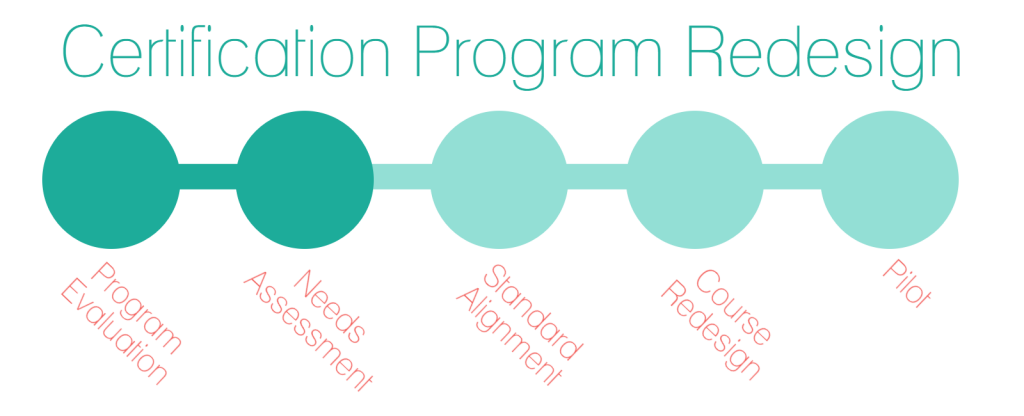
In an earlier post, I wrote about my journey in reviewing and redesigning a university’s Library Media Endorsement (LME) certification program. Here, I continue that work by drafting a Needs Assessment survey for potential students. As I mentioned in my last post, the program is not yet finalized, so I am omitting the name of the institution and it will henceforth be identified as “University.”
Before writing the Needs Assessment survey, I did a bit of background research, attempting to see how other schools have assessed their incoming … Read More
]]>
One of the biggest takeaways from my time in the Digital Education Leadership program through Seattle Pacific University is that teachers are students, too. When diving into effective mentoring and professional development, some of the most successful strategies are those that are also used in the classroom. Many back-to-school workshops remind teachers to get to know their students and provide differentiation in every learning experience. In other words, providing learners (adults included) with a pre-assessment (formal or informal) to determine where they are in order to reach where they need to be.
Edutopia has a great article and video that touches on the importance of assessment before learning even begins:
In an earlier post, I wrote about my journey in reviewing and redesigning a university’s Library Media Endorsement (LME) certification program. Here, I continue that work by drafting a Needs Assessment survey for potential students. As I mentioned in my last post, the program is not yet finalized, so I am omitting the name of the institution and it will henceforth be identified as “University.”
Before writing the Needs Assessment survey, I did a bit of background research, attempting to see how other schools have assessed their incoming … Read More
]]>

While the entire Digital Education Leadership program at Seattle Pacific University is designed to be a hands-on experience which embeds learning opportunities into students’ current workplace, this course, in particular, provided students with a meaningful opportunity to practice our newfound skills in a professional environment. Under the tutelage of Dr. David Wicks, Associate Professor and Chair of the Digital Education Leadership program and Dr. Les Foltos, Director of Educational Innovation at Peer-Ed and author of Peer Coaching: Unlocking the Power of Collaboration, students were trained as peer coaches and we worked with a collaborating teacher from our respective schools. I chronicled that learned and the skills I obtained in posts throughout the quarter and now, as this course comes to a close, I’m reflecting on the work that was done and thinking about how to sustain my skills as a peer coach in the future.
The importance of peer coaching practice in schools became evident to me very quickly into the quarter. Teachers that are supported create students that are successful. Well-renowned researchers of teaching methods and staff development, Bruce Joyce and Beverly Showers, have found that teachers that have been coached generally demonstrate the following:
- Practiced
While the entire Digital Education Leadership program at Seattle Pacific University is designed to be a hands-on experience which embeds learning opportunities into students’ current workplace, this course, in particular, provided students with a meaningful opportunity to practice our newfound skills in a professional environment. Under the tutelage of Dr. David Wicks, Associate Professor and Chair of the Digital Education Leadership program and Dr. Les Foltos, Director of Educational Innovation at Peer-Ed and author of Peer Coaching: Unlocking the Power of Collaboration, students were trained as peer coaches and we worked with a collaborating teacher from our respective schools. I chronicled that learned and the skills I obtained in posts throughout the quarter and now, as this course comes to a close, I’m reflecting on the work that was done and thinking about how to sustain my skills as a peer coach in the future.
The importance of peer coaching practice in schools became evident to me very quickly into the quarter. Teachers that are supported create students that are successful. Well-renowned researchers of teaching methods and staff development, Bruce Joyce and Beverly Showers, have found that teachers that have been coached generally demonstrate the following:
- Practiced

My ideal learning environment is one where students:
- Guide their own learning by asking questions and following curiosities.
- Explore ideas that pique their interest, thereby formulating their own units of study.
- Work collaboratively with others both inside and outside of the classroom in an effort to pursue those interests.
- Are encouraged to move freely while still understanding the importance of coming back together and being respectful to others.
- Trust their own instincts and grow into responsible “decision-making” and “self-reliant” learners (Saxena, 2013).
- Have access to the world, in whatever form that makes sense in that time and place.
- Learn from one another.
My ideal learning environment is one where teachers:
- Feel comfortable in stepping down from the stage and allow students to see that they don’t know everything, but they are interested in learning alongside their students.
- Have ample opportunities for asking questions and taking risks while feeling supported and
My ideal learning environment is one where students:
- Guide their own learning by asking questions and following curiosities.
- Explore ideas that pique their interest, thereby formulating their own units of study.
- Work collaboratively with others both inside and outside of the classroom in an effort to pursue those interests.
- Are encouraged to move freely while still understanding the importance of coming back together and being respectful to others.
- Trust their own instincts and grow into responsible “decision-making” and “self-reliant” learners (Saxena, 2013).
- Have access to the world, in whatever form that makes sense in that time and place.
- Learn from one another.
My ideal learning environment is one where teachers:
- Feel comfortable in stepping down from the stage and allow students to see that they don’t know everything, but they are interested in learning alongside their students.
- Have ample opportunities for asking questions and taking risks while feeling supported and
As I move forward in my examination of GAFE, a suite of productivity applications that Google offers free to schools, I am going to look at the pros and cons and how those nuances might play a role in the adoption of this learning tool. With that being said, this is not a review of GAFE, it’s not a comparative list between GAFE and Microsoft. It’s a question of whether or not this specific tool can meet the specific needs of my faculty and students. In his article, Computer Criticism vs. Technocentric Thinking, Seymour Papert argues that when evaluating a new … Read More
]]>As I move forward in my examination of GAFE, a suite of productivity applications that Google offers free to schools, I am going to look at the pros and cons and how those nuances might play a role in the adoption of this learning tool. With that being said, this is not a review of GAFE, it’s not a comparative list between GAFE and Microsoft. It’s a question of whether or not this specific tool can meet the specific needs of my faculty and students. In his article, Computer Criticism vs. Technocentric Thinking, Seymour Papert argues that when evaluating a new … Read More
]]> While I’m still in the process of wrestling with those ideas, my (wildly supportive) classmates and professors gave me a great deal of thought-provoking feedback throughout the week. Annie Tremonte, one of my classmates suggested using this blog post as a platform to flush out my ideas and reflect on the feedback I was provided from others. This format is very foreign for me and I encourage you to continue to provide me your additional thoughts and reactions, allowing me to continue to grow my ideas in a very transparent way.
Reflections on the Feedback
“While focusing on … Read More
]]>While I’m still in the process of wrestling with those ideas, my (wildly supportive) classmates and professors gave me a great deal of thought-provoking feedback throughout the week. Annie Tremonte, one of my classmates suggested using this blog post as a platform to flush out my ideas and reflect on the feedback I was provided from others. This format is very foreign for me and I encourage you to continue to provide me your additional thoughts and reactions, allowing me to continue to grow my ideas in a very transparent way.
Reflections on the Feedback
“While focusing on … Read More
]]>
While all of these tools serve an excellent purpose, how are they working together to create a well-rounded, transformative experience for our students? Tech coach, Josiah Hodgett from the Shell Lake School District writes, “GAFE is a technology tool that can help you to both inform and instruct. Coming from a theory like TPACK [Technological, Pedagogical, Content Knowledge] – it’s time to look at the interplay of Tech – Pedagogy – Content and determine how they … Read More
]]>
While all of these tools serve an excellent purpose, how are they working together to create a well-rounded, transformative experience for our students? Tech coach, Josiah Hodgett from the Shell Lake School District writes, “GAFE is a technology tool that can help you to both inform and instruct. Coming from a theory like TPACK [Technological, Pedagogical, Content Knowledge] – it’s time to look at the interplay of Tech – Pedagogy – Content and determine how they … Read More
]]>
I work at a private school where many of the teachers are not formal educators; they come to the school with a strong background in the school’s cultural and religious beliefs, but not in classroom teaching. I have noticed that many of them do not pursue professional development opportunities that could help them advance their skills in classroom management, assessment, or effective teaching. Blogger and widely respected technology integration specialist, Vicki Davis states, “Professional development is a vital part of improving your technique as a teacher. Learning best practices and practicing best practices are both important. You can make a school better by improving its teachers. Effective [professional development] can do that” (2015). With this in the forefront … Read More
]]>
I work at a private school where many of the teachers are not formal educators; they come to the school with a strong background in the school’s cultural and religious beliefs, but not in classroom teaching. I have noticed that many of them do not pursue professional development opportunities that could help them advance their skills in classroom management, assessment, or effective teaching. Blogger and widely respected technology integration specialist, Vicki Davis states, “Professional development is a vital part of improving your technique as a teacher. Learning best practices and practicing best practices are both important. You can make a school better by improving its teachers. Effective [professional development] can do that” (2015). With this in the forefront … Read More
]]>My school recently revisited our Acceptable Use Policy (AUP) after not having revised it in over two years. We found several discrepancies and have noted that several parents, while they signed the document, still had an array of questions about the one-to-one laptop program and what the laptops should (and shouldn’t) be used for both on and off campus. With this in mind, the school’s Tech Task Force debated the idea of requiring students and parents to attend an orientation in addition to just signing the AUP. I reviewed the policies and procedures of several other schools in an effort to find what works best for the majority. It seems, there is no majority. All schools approach this issue differently, with varying levels of success. What works for one school, doesn’t work for the … Read More
]]>My school recently revisited our Acceptable Use Policy (AUP) after not having revised it in over two years. We found several discrepancies and have noted that several parents, while they signed the document, still had an array of questions about the one-to-one laptop program and what the laptops should (and shouldn’t) be used for both on and off campus. With this in mind, the school’s Tech Task Force debated the idea of requiring students and parents to attend an orientation in addition to just signing the AUP. I reviewed the policies and procedures of several other schools in an effort to find what works best for the majority. It seems, there is no majority. All schools approach this issue differently, with varying levels of success. What works for one school, doesn’t work for the … Read More
]]>I recently attended an EdCamp (if you’re unfamiliar with the term, this video is a must) where I met with several librarians who were talking about the need for basic computer skill instruction. After much discussion and reflecting on the standard for this week, I was left asking myself the following question:
How can the library play a central role in facilitating a scope and sequence of computer skills for students in the … Read More
]]>I recently attended an EdCamp (if you’re unfamiliar with the term, this video is a must) where I met with several librarians who were talking about the need for basic computer skill instruction. After much discussion and reflecting on the standard for this week, I was left asking myself the following question:
How can the library play a central role in facilitating a scope and sequence of computer skills for students in the … Read More
]]>